
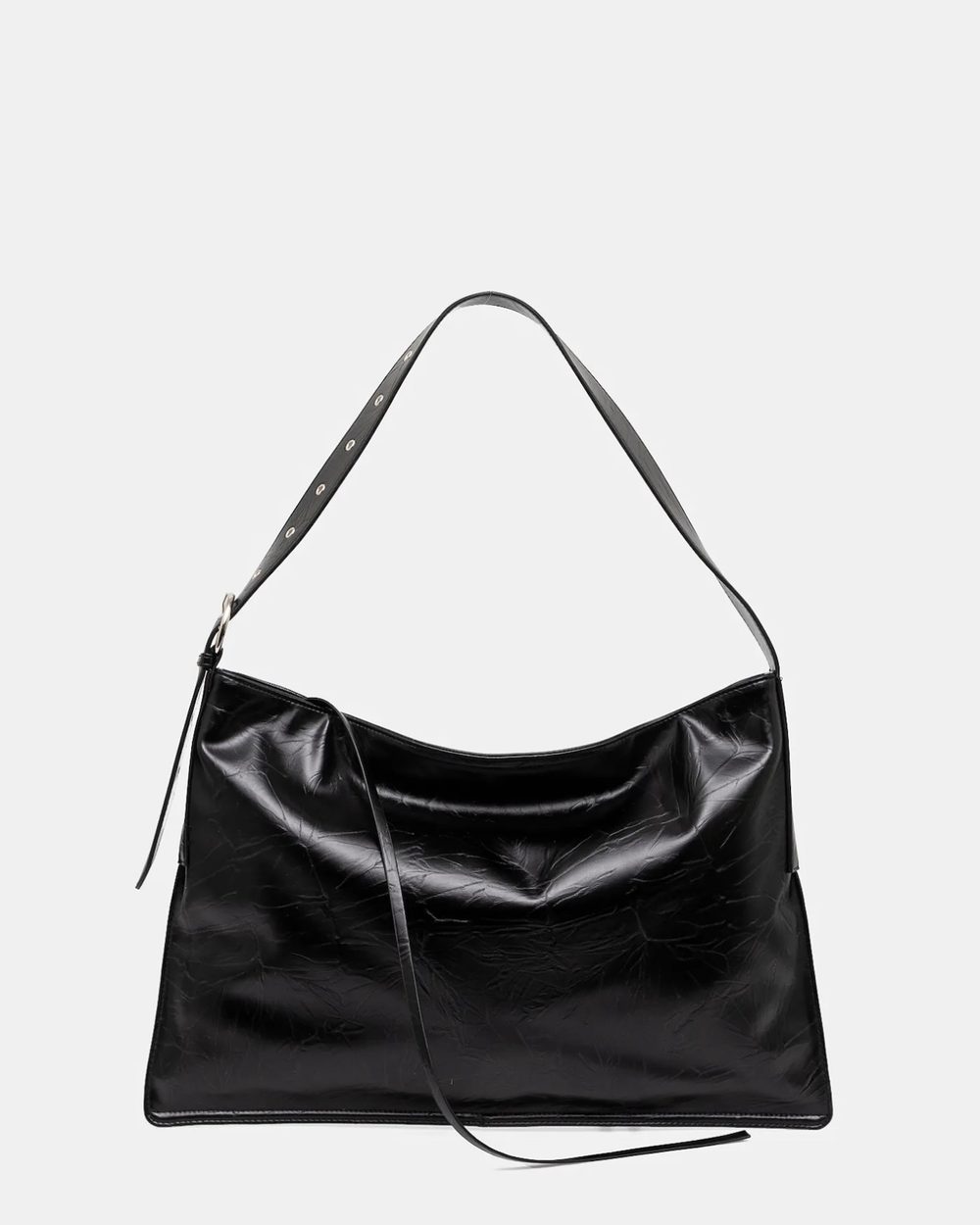
Short answer
Six things give leather away: its smell, the texture of the cut edge, the irregularity of the pores, whether it creases and recovers when pressed, its weight, and the wording on the label. The quickest check is the cut edge — real leather shows a fibrous cross-section, synthetic shows a flat plastic layer.
Six tests
- Smell. Real leather smells of earth, tobacco and something faintly sweet. Synthetic smells sharply chemical, or of nothing at all. This is the fastest tell there is.
- The cut edge. Look at where a strap or a flap has been cut. Real leather shows an irregular, fibrous, almost velvety cross-section. Synthetic shows a flat plastic layer spread over a fabric backing.
- Pore pattern. On real hide the pores are irregular — dense in one place, sparse in another. On synthetic the grain is printed, so the same motif repeats every few centimetres. Look closely and you'll catch the repeat.
- The press test. Press with your thumb. Real leather creases under the pressure and then slowly recovers. Synthetic either doesn't crease at all, or creases and stays that way.
- Weight and warmth. Leather is heavier than synthetic of the same size, and warms in your hand within seconds. Synthetic stays cool.
- A drop of water. Untreated leather absorbs a small drop within seconds; synthetic keeps it sitting on the surface. Do this somewhere hidden, not on a visible panel — on some finishes it can leave a mark.
What the words on the label mean
"Genuine leather" is not the quality grade people assume it is; it only says animal hide was used. The real information is in which layer of the hide you're getting.
| Label | What it means | How it ages |
|---|---|---|
| Full grain | The top layer of the hide, unsanded | The most durable; develops a patina over years |
| Top grain | Top layer lightly sanded for evenness | Durable; the material of most good bags |
| Genuine leather | Lower layers; "genuine" is marketing wording | Middling; the surface tires within a few seasons |
| Bonded leather | Leather scraps glued onto a backing | Weak; peels from the edges |
| PU / vegan leather | Not leather; a polyurethane coating | Good ones last 2–3 seasons, poor ones crack in one summer |
Is faux leather always worse?
No. A good polyurethane outlives a bad bonded leather comfortably. It also has real advantages: it doesn't stain in rain, it wipes clean, and it's light. Some labels choose it deliberately — JW Pei, for instance, builds its whole collection on vegan materials.
The question to ask before deciding is simple: how many seasons do you intend to carry this bag? For a colour you want to try for one summer, synthetic is a sensible choice. For a shoulder bag you want in ten years' time, it isn't.
Judging material from photos online
When you can't touch the piece, three photographs are enough:
- A close-up of the cut edge — a strap or flap edge. Fibre or plastic layer: it shows in that one frame.
- The fold — where a strap bends. Real leather makes soft creases there; synthetic leaves a hard, sharp fold line.
- Lining and stitching — how many stitches per centimetre, how even the run is. A well-sewn lining is the most honest thing you can learn about workmanship, whatever the material.
Then look at the photograph itself: studio lighting makes leather look lighter and smoother than it is. That's exactly why our live shots page exists — pieces as they came out of the box, unretouched.